Client
A Global Supply Chain Leader
Our client is a worldwide leader in supply chain solutions, specializing in cargo logistics, terminal operations, and maritime services. With a workforce of more than 100,000 employees and a presence in more than 80+ countries, the organization manages an impressive portfolio of 80+ marine and inland terminals worldwide.
Challenge
Operational Roadblocks Affecting Information Synergy
- Fragmented Legacy Landscape: 18 entities in 10+ countries ran on fragmented legacy platforms (Microsoft Dynamics 365 in some geographies), each with its own chart of accounts and localization patches, leading to inconsistent processes and inefficiencies across geographies
- High Operational Costs and Limited Scalability: Legacy platforms required high maintenance costs, and a lack of scalability hindered business growth as new entities were onboarded post-acquisition.
- Limited Real-time Global Visibility: Fragmented systems and reporting hindered timely access to real-time enterprise-wide insights for effective decision making.
- Compliance Risks: Country-specific tax/regulatory requirements were not natively supported, creating compliance gaps and audit exposure.
- Inefficient Supplier and Cash Flow Management: Disconnected P2P and banking systems limited supplier negotiation leverage and cash visibility.
- Rigid Systems Hindering Agility and Innovation: The legacy application landscape lacked the flexibility to adapt quickly to evolving technology changes and impacted digital transformation goals.
Solution
Oracle Fusion Cloud for Unified, Streamlined Global Operations
The Hexaware Partnership
Hexaware supported the client in driving a comprehensive digital transformation by implementing and rolling out Oracle Fusion Cloud, leveraging the global template to standardize and streamline processes across geographies. This initiative involved the seamless integration of maritime systems and the automation of critical business processes.
Core Implementation/ Rollout and Support
- Rolled out a single global Fusion template across 18 entities in 10+ countries, retiring the legacy/D365 instances and standardizing the chart of accounts.
- Integrated Oracle Fusion Cloud with complex maritime procurement and billing systems.
- Integrated Fusion with 30+ systems, including multiple international banks, for straight-through payment processing.
- Consolidated Finance, Procurement, and Inventory into one global source of truth on Fusion.
- Delivered localized solutions inside the global template rather than one-off custom code for countries not natively supported by Oracle Fusion Cloud.
Solutions for Unique Requirements
| Requirement |
Why did the global template not cover it |
Solution delivered |
| Withholding tax treatment on AR transactions — Australia |
The standard global template modeled withholding tax as an AP-side concept; Australian statutory rules also require it to be calculated and reported on specific AR transaction types. |
Extended the tax engine configuration to apply withholding logic on qualifying AR transactions, leveraging standard Oracle Fusion Cloud setup rather than building custom code — avoiding future upgrade risk. |
| Country-specific e-invoicing / statutory reporting |
The standard template did not natively support local statutory invoice interfaces. |
E-Invoicing — Harbour Management System (HMS): Revenue invoices interfaced to Cloud Receivables in Oracle Fusion Cloud for Cyprus and Mozambique. |
| Bank connectivity / payment-format exception |
Unique local bank payment formats not covered by standard connectivity. |
H2H connectivity with a unique ABA format for Australia and PNG. |
| NSE Integration (Procurement/Inventory replacement) |
Legacy procurement/inventory processes not integrated with Oracle Fusion Cloud. |
End-to-end bi-directional data flow of the procurement and inventory management process — requisitions to receipts/onhand. |
Digital and Automation Initiatives
- We helped the client to leverage autonomous, intelligent workflows and embedded AI agents to enable a faster, more predictable rollout, thereby reducing effort, timelines, and costs by ~30%. By consolidating finance and procurement functions into a single, unified global Oracle Fusion Cloud instance, the client realized significant business benefits, including:
- Standardized operations and enhanced process efficiency.
- Cost savings and scalable growth.
- Real-time, global business visibility.
- A risk-free, compliant operating environment.
- Optimized supplier relationships and improved cash flows.
- With standardized data and integration templates, project complexity was further minimized and consistent reliable outcomes were ensured. The client benefits from an agile, future-ready platform powered by autonomous, intelligent workflows and tailored AI agents.
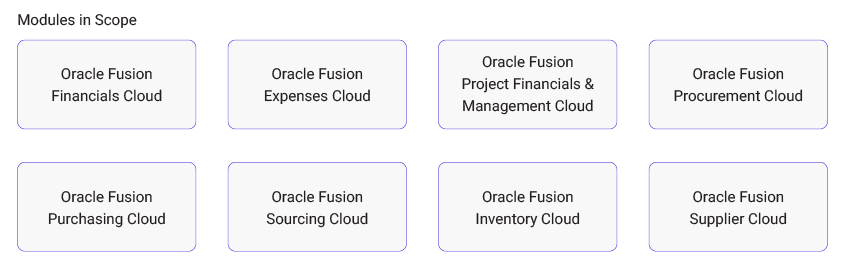
Fig 1: Modules in scope
Benefits
Better Cost, Accuracy, and Productivity
| Challenge (baseline) |
What Hexaware did |
Resulting benefit |
| 18 entities in 10+ countries ran on fragmented legacy platforms (Microsoft Dynamics 365 in some geographies), each with its own chart of accounts and localization patches. |
Rolled out a single global Oracle Fusion Cloud template across 18 entities in 10+ countries, retiring the legacy/D365 instances and standardizing the chart of accounts. |
Unified definition of cost/revenue categorization; faster, reliable group-level reporting; segment-level visibility (e.g., by project, cost center, or business line) — useful for portfolio-level decisions (which terminals/entities are cost-efficient, where to invest). |
| Legacy platforms were costly to maintain and couldn’t scale as new entities were onboarded post-acquisition. |
Built a reusable global template + localization layer so new entities plug into a proven data model instead of a custom build. |
the last wave. |
| Fragmented systems meant no real-time, enterprise-wide view for leadership decision-making. |
Consolidated Finance, Procurement, and Inventory into one global source of truth on Fusion. |
Cycle-time reduced by 25%, so leadership gets real-time cross-entity reporting. |
| Country-specific tax/regulatory requirements were not natively supported, creating compliance and audit exposure. |
Delivered localized solutions inside the global template rather than one-off custom code (see innovation examples above). |
Statutory/compliance coverage achieved in all 18 entities in 10+ countries at go-live, with zero major compliance findings post go-live. |
| Disconnected P2P and banking systems limited supplier negotiation leverage and cash visibility. |
Integrated Oracle Fusion Cloud with 30+ systems including multiple international banks for straight-through payment processing. |
Improved working capital and cash visibility through straight-through payment processing, enabling faster decision-making, optimized liquidity management, and a 20-30% reduction in payment cycle times while strengthening global banking relationships. |
|
|
|
Summary
Enhanced Global Operational Excellence with Oracle Fusion Cloud
Hexaware’s strategic Oracle Fusion Cloud implementation/rollout enabled the client to achieve an efficient, cost-competitive, compliant, and standardized operational model by consolidating systems into a unified digital backbone for global operations. Following a successful POC, the solution was rolled out across 18 entities in 10+ countries over an 18-month period, delivered in two phases, including post-production support. The program was completed on schedule, with no major P1/P2 incidents reported post go-live. Leveraging autonomous, intelligent workflows and embedded AI agents, the client is now positioned for continued growth and transformation.
Ready to transform your global operations?
Discover how Hexaware’s Oracle Fusion Cloud implementation/rollout can standardize processes, cut costs by ~30%, and deliver real-time enterprise-wide visibility — just as it did for a global logistics leader across 18 entities in 10+ countries.