Organizations are steering towards digital supremacy by making data-driven decisions in an increasingly diverse, distributed, and complex environment. The unprecedented pace of change across business and innovation drives organizations to be data-centric to quickly deliver the required business insights and customer needs.
Organizations have their data residing at multiple locations (on-premises, private cloud, public cloud) and in different formats (structured, semi-structured, unstructured). As more data gets generated every second, the landscape becomes further complex to manage and use.
Organizations use multiple data integration tools which makes it difficult to quickly ingest, integrate, analyze, share the data and add new data source.
Traditional data management practices are not adequate to tackle the below mentioned data management challenges:
- High-cost and low-value data integration cycles
- Frequent maintenance of earlier integrations
- Rising demand for real-time insights and data sharing
To overcome these challenges and attain data management agility, organizations can leverage the emerging design concept called “Data Fabric”.
In this data-driven age, organizations spend a disproportionate amount of time on routine tasks and not enough on value addition. A survey by Gartner titled “Data Management Struggles to Balance Innovation and Control” found that data teams can devote only 22% of their time to innovation. The remaining efforts are spent on maintaining production initiatives, training users, and other non-value-adding tasks. Data fabric rectifies this balance and frees up top and promising talent’s time by removing back-end bottlenecks in data management.
What is Data Fabric:
To stay agile and competitive, enterprises need improved access and visibility to data and may have to attain it from disparate sources. Navigating through the complex data landscape can be a daunting task. Data Fabric leverages continuous analytics to act as a connector between data endpoints and enhances data management capabilities across on-premises and multi-cloud environments.
Data Fabric is a single environment with unified architecture, technologies and services running on it, enabling companies to manage their data. Data Fabric helps in accessing data by connecting multiple locations, types and formats of data. Data can be stored, processed and managed while it moves within the Data Fabric. It can be accessed or shared with internal and external applications for a wide variety of organizational uses.
It continuously discovers and connects data from different applications to identify unique business insights between all the available data points. In addition to that, it also performs auto-healing of failed data integration jobs and auto-profiling of datasets.
Why Data Fabric?
Data fabric helps organizations to emerge as digital leaders by:
- Offering a single environment – eliminating data silos
- Enabling unified and simplified data management by removing the usage of multiple tools and providing access to accurate data
- Providing great scalability to adapt large volumes of data, data sources
- Delivering faster migration between different environments by eliminating dependency on legacy solutions and infrastructure
- Easing the addition of new data sources and technologies to the Data Fabric without changing existing data connections
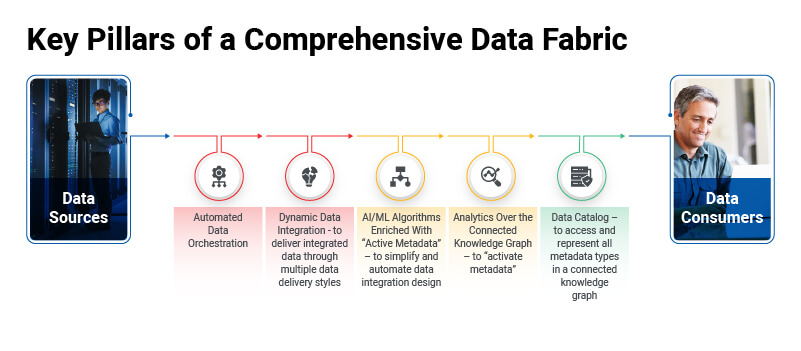
The 5 Key Pillars of Data Fabric
- The ability to identify, integrate, segment, and share large volumes and varied forms of metadata (Technical, runtime, business, social)
- The ability to perform analytics over connected metadata in a knowledge graph (Analyze and convert passive metadata to active metadata)
- The ability to use AI/ML algorithms to deliver “just-in-time” data management infrastructure and processing maps for data integration use cases
- A strong data integration backbone – Without a strong integration backbone that can support different styles, a Data Fabric will fail to scale beyond traditional data integration use cases
- The ability to automate data orchestration
Use Cases for a Data Fabric Architecture
Here are a few Data Fabric use cases
- Unlocking the true power of data – Self-service and real-time data access help businesses access data with ease and leverage insights for better decision-making.
- Governance and Security Automation – Accelerated deployment of industry-specific governance regulations enabling automatic policy enforcement regarding data access.
- Data integration across environments – Facilitate access to reliable data and automate data engineering to simplify the access. Augment data efficiency by leveraging data management capabilities.
Conclusion
The real advantage that comes with a Data Fabric is that it can ingest data from varied data sources and in a variety of formats regardless of technology. It uses its own data store to process and secure the data, getting it ready for consumption in applications, decision-making and AI engines. An operational Data Fabric can integrate, process, and deliver enterprise data in real-time.
For use cases with enormous scale and volume, Data Fabric emerges as the preferred option as compared to data lake or data warehouse. However the data landscape becomes sturdier when the capabilities of these architecture formats are combined. Data Fabric can prepare trusted data for Data Lakes and Warehouses and on the other hand, lakes and warehouses can provide insights back to the Data Fabric for real-time data.